
· 10 min read
B2B Sales Stack: How to Choose and Integrate Tools
By Roadmap Sales

As a sales operation grows, the stack of sales tools typically grows alongside it. First comes the CRM. Then automation, prospecting, telephony, BI, electronic signatures, ERP, marketing, and customer service follow. Before long, the team experiences a curious effect: there are more systems, but not always more control.
A well-constructed B2B sales stack is the set of tools that supports the sales process without creating friction between data, people, and routines.
We see this frequently. The company purchases good solutions but fails to define ownership of the process, registration rules, funnel stages, or integration criteria. The results appear quickly: duplicated information, weak forecasts, poor handoff between marketing and sales, and managers lacking confidence in the numbers.
This is why the topic has gained importance in modern operations. In B2B sales, the cycle is often longer, involving more participants, follow-up tasks, contact history, and a dependency on predictability. Without a coherent technological foundation, the team loses momentum. And they lose their margin for error.
At Roadmap Sales, we advocate a simple logic: technology should follow the process, not the other way around. Before thinking about the number of tools, it’s worth considering function, integration, and alignment with the team’s profile.
What Comprises a B2B Sales Stack
Not every operation needs ten systems. In many cases, three blocks can resolve a significant portion of the work when well chosen and connected. These are: CRM, prospecting engine, and revenue intelligence.
The CRM is the core data hub of the sales operation.
It consolidates accounts, contacts, deals, activities, pipeline, history, and metrics. In practice, it’s where the team records what has happened, what is ongoing, and what needs to happen next. It also serves as the basis for managing forecasts, conversion rates, cycle times, and performance by channel or salesperson.
The prospecting engine supports opportunity generation. It may include a lead database, data enrichment, cadences, email sending, dialers, automated tasks, and segmentation rules. Its role is to maintain the rhythm of opening new conversations with companies within the ICP.
The revenue intelligence layer completes the trio. This includes analytical resources, dashboards, pipeline reading, data quality, portfolio health, and risk or progress signals in deals. This part helps management move away from guesswork and make decisions based on evidence.
More tools do not mean more control.
When these three blocks communicate with each other, the sales team works with less rework. When they do not communicate, parallel spreadsheets, half-filled fields, and a funnel that appears organized but is not emerge.
How Each Category Works in Practice
It’s worth bringing the discussion to everyday scenarios. Imagine a sales team in a B2B company with 30 salespeople, SDRs, and leaders. Marketing generates demand, SDRs qualify leads, executives conduct meetings, and post-sales need to receive the history without noise. This flow only runs smoothly when each tool has a clear mission.
In the CRM, common functions include:
- Registration of companies, contacts, and responsible parties.
- Pipeline management by stage, source, and product.
- Activity logging, meetings, calls, and emails.
- Forecasting by salesperson, team, or period.
- Conversion, aging, and sales cycle reports.
In the prospecting engine, typical features include:
- Creation of lists by account profile.
- Data enrichment for contacts and companies.
- Cadences with multichannel tasks.
- Lead distribution by rules.
- Response monitoring and progress by stage.
In revenue intelligence, the team begins to see:
- Deals without recent activity.
- Inflated pipeline due to opportunities without fit.
- Discrepancies between forecast and actual closure.
- Bottlenecks by salesperson, segment, or source.
- Slowing velocity in strategic accounts.
If the operation does not know where the data originates, who updates it, and where it goes, the stack has already started off wrong.
When we help companies review this design, many discover that the problem was not a lack of software. It was a lack of architecture.
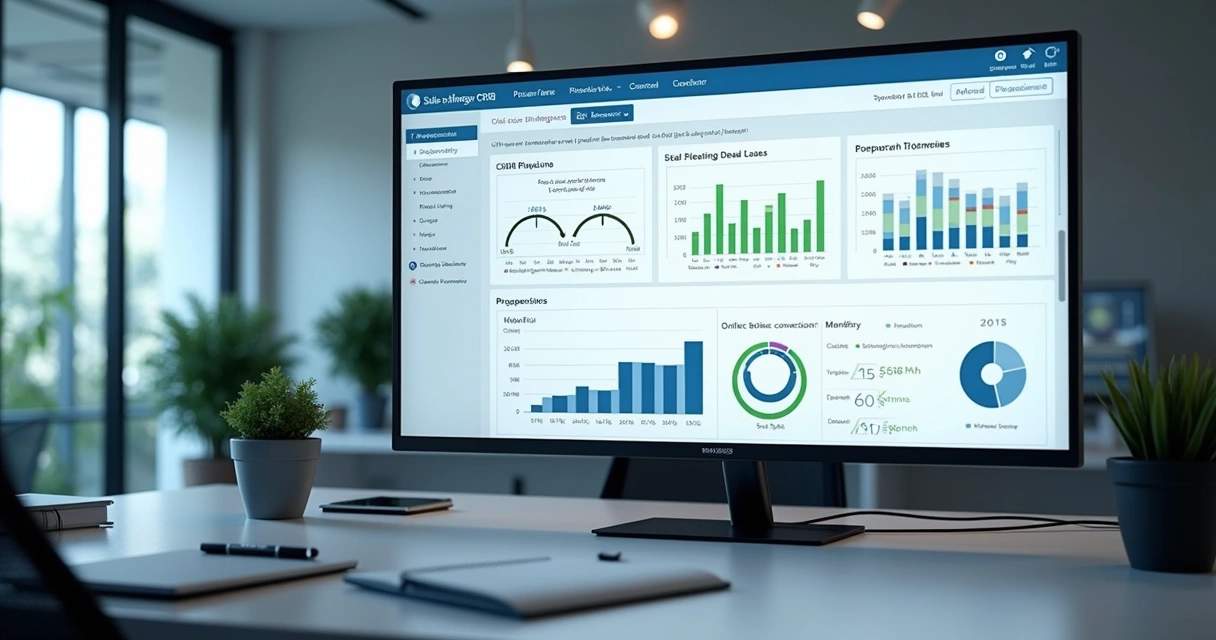
How to Avoid Frankenstack
There is a common problem in growing companies: each area buys a solution to address its immediate pain. Sales chooses a tool for funnel management. Marketing hires another for automation. Finance pulls data from the ERP. Customer Success keeps information in another system. Without a common design, Frankenstack is born.
Frankenstack is the software stack built in parts, with overlapping functions, weak integration, and disconnected data.
The signs are easy to notice:
- The same field exists in three systems and never matches.
- The salesperson has to copy and paste data manually.
- The manager uses spreadsheets to correct CRM reports.
- The areas argue about which number is correct.
- The team does not know which system is the official source.
We have seen operations like this. And the feeling within the team is poor. No one fully trusts the data. Meetings become longer. Pressure increases. And the system starts to be treated as an obligation, not as support.
To avoid this, the first step is to define the minimum architecture. Which system will be the primary source of commercial data? Where does the lead enter? When does it become an opportunity? When does it go to proposal? Who updates what? Which integrations are native and which require connectors?
How to Choose the Right CRM
The CRM should not be chosen based on the volume of isolated features. The key point is adherence to the sales model. We suggest looking at five practical criteria.
- Structure of the sales process. The system needs to accommodate your real funnel, your fields, your SLAs, and your logic for moving between stages.
- Ease of use. If the salesperson struggles to log activities, the data loses quality.
- Integration capability. An isolated CRM creates information silos.
- Management and reporting. The leader needs to quickly read pipeline and forecast.
- Total implementation cost. It’s not just the license. There’s setup, training, process review, and maintenance.
The best CRM is not the most famous one, but the one that best fits the process, size, and maturity of the team.
For those in this decision phase, we have already compiled objective criteria in a guide to choosing a CRM. It helps reduce choices made solely due to commercial pressure or trends.
It also makes sense to compare categories and features in a broader market view. At this stage, our directory of sales and CRM tools helps organize the analysis without losing focus on the process.
Integrations That Make a Difference
Not every integration needs to come in the first month. But some connections often generate quick impact on the operation’s routine.
Among the most useful integrations, we highlight:
- CRM with marketing automation, for lead entry and source tracking.
- CRM with telephony or dialer, to log contact and activity volume.
- CRM with email and calendar, to synchronize meetings and history.
- CRM with ERP or finance, for customer handoff and revenue visibility.
- CRM with BI, to consolidate management metrics.
If your operation is already evaluating environments like RD Station, Pipedrive, or HubSpot, the point is not just to look at the interface. It’s to understand how each option behaves within the sales flow and the integrations you truly need.
A good integration is one that eliminates rework without creating new hidden steps.
This detail changes everything. Sometimes a connection seems ready, but it does not transfer critical fields, does not respect ownership rules, or creates duplication. Therefore, before activating any automation, it’s worth mapping the source event, the data destination, and the exceptions.

How to Build the Stack According to Company Size
An operation with 10 people does not need the same design as a company with 200 employees. This may seem obvious, but many wrong purchases stem from comparisons with businesses of different sizes.
For smaller teams, we usually recommend focusing on simplicity. A well-configured CRM, integration with email, calendar, and a basic layer of prospecting can already support growth. The risk here is hiring too many systems too soon.
In medium-sized companies, the scenario changes. Management begins to demand data governance, portfolio segmentation, automation, distribution rules, and channel predictability. At this point, it makes sense to add revenue intelligence, more robust connectors, and integration with ERP or BI.
In more mature structures, the challenge shifts from merely operating to standardizing. This is where field taxonomy, naming conventions, duplication rules, SLAs between areas, and living process documentation come into play.
A good commercial stack evolves with the company’s maturity without becoming larger than the process can support.
At Roadmap Sales, we see great value in starting with what is necessary and evolving in phases. This reduces implementation errors and avoids a common problem: the team learns the wrong system for a process that was not yet clear.
Process Before Technology
In many projects, the company asks which software to buy. We prefer to reverse the conversation. First, we design the process. Then, we evaluate the technology.
This includes answering objective questions:
- What is the ICP and how does it enter the funnel?
- What criteria define lead, MQL, SQL, and opportunity?
- What stages of the pipeline actually exist?
- What activities need to be mandatory at each phase?
- What indicators does management need to track weekly?
Without this design, the risk is high. The tool becomes a repository of loose data. And worse: the operation begins to discuss configuration instead of discussing sales.
Clear process. Coherent tool.
When the foundation is correct, technology accelerates what already makes sense. When the foundation is poor, it amplifies confusion.
Conclusion
Building a B2B sales stack is not about piling software. It’s about defining a reliable data foundation, choosing tools with clear functions, and connecting everything to the real process of the operation. CRM, prospecting, and revenue intelligence can generate significant value, provided each piece has a well-defined role and consistent integration.
We believe that sales leaders gain a lot when they approach this decision methodically. Less improvisation, less rework, more pipeline visibility, and greater confidence in the numbers. If your company is at this decision or review stage, it’s worth getting to know Roadmap Sales and conducting a diagnosis to receive a recommendation aligned with your size, budget, and commercial maturity.
Frequently Asked Questions
What is a B2B sales stack?
It is the set of tools that supports sales operations between companies, including CRM, prospecting, automation, analysis, and integrations.
In practice, this stack organizes data, activities, pipeline, opportunity generation, and commercial management. When well designed, the team works with more clarity, and leadership can confidently track the funnel.
How to integrate tools in the sales stack?
The first step is to define which system will be the primary source of data and which events need to be shared between platforms.
After that, we map fields, responsibilities, update rules, and duplication handling. The integration should follow the commercial process, not just the technical availability of a connector. It’s worth starting with what reduces manual tasks and improves funnel visibility.
What are the best tools for B2B sales?
There is no one-size-fits-all answer. The best tools are those that fit the process, the size of the company, the maturity level of the team, and the necessary integrations. A good stack typically combines CRM, prospecting resources, and revenue intelligence without excessive overlap.
Therefore, we prefer to evaluate adherence, ease of use, integration capability, report quality, and total implementation cost before making a choice.
How to choose the ideal stack for my business?
We start with the commercial process, the team profile, and the indicators that management needs to track.
From there, it becomes easier to define which tools should be included now, which can wait, and which would only generate cost and noise. Smaller companies tend to benefit more from simplicity. More mature operations require more governance, integration, and managerial visibility.
Is a B2B sales stack really worth it?
Yes, as long as the stack of tools is coherent with the team’s routine and the sales model.
When this happens, the operation reduces rework, improves data recording, gains visibility over the pipeline and forecast, and makes decisions with more confidence. When the stack is built without criteria, the effect can be the opposite. Therefore, making the right choice makes all the difference.
Want this tailored to your stack?
Run the free assessment and get a personalized report with fit scores, tradeoffs, and rollout guidance.
Start free assessment