
· 23 min read
Sales Automation on WhatsApp: How to Integrate with CRM
By Roadmap Sales

When a B2B company starts selling more through WhatsApp, the same problem often arises. Conversations increase, contacts become scattered, salespeople start responding from different numbers, and soon, no one knows exactly what stage each opportunity is in.
We see this frequently. The operation grows, but it grows with noise. Messages go unanswered. Follow-ups are forgotten. Information about budget, deadlines, and lead interest ends up trapped on someone’s phone. What seemed like closeness to the customer turns into disorganization.
Automating the sales process on WhatsApp does not mean robotizing sales; it means creating order, context, and continuity.
In the corporate context, WhatsApp sales automation makes more sense when connected to a CRM. This integration allows for recording interactions, distributing service requests, tracking lead history, and measuring the actual progress of the pipeline. Without it, the channel remains active, but management remains fragile.
This shift has gained momentum because WhatsApp is already part of the daily routine of Brazilian companies. According to a FGV study on the use of messaging apps as the primary digital channel, 80% of the companies surveyed already use this type of app as their central digital channel, and 65% have at least one active digital sales channel. Market behavior has already changed. Now, the commercial structure needs to keep up.
At the same time, there is still a disconnect between having many conversations and recording them well. A Sebrae survey on small businesses using WhatsApp as their primary means of communication shows that over 80% of service businesses rely on the app to communicate with clients, but many of these companies still operate without a formal CRM and with little record of interactions. The risk is clear. Without reliable history, sales depend too much on the team's memory.
We believe this is a turning point for small and medium B2B companies. It is not enough to be on the channel where the customer responds fastest. It is necessary to transform that conversation into a process, data, and predictability.
A channel without records becomes a bottleneck.
In this article, we will explain how the integration between WhatsApp and CRM works, what resources are involved in this operation, how to choose tools wisely, and what types of automated flows genuinely help in the commercial routine. We will also show how this topic connects to the work of Roadmap Sales, which helps Brazilian companies evaluate CRM and sales tools based on real adherence, not generic promises.
Why has WhatsApp become part of the commercial operation?
For a long time, WhatsApp was seen only as a quick contact channel. Something useful for confirming meetings, sending proposals, or answering simple questions. That has changed. Today, in many companies, a significant part of the commercial relationship starts, advances, and even closes there.
The reason is simple. The customer is already on the app. They respond more quickly, ask questions without excessive formality, and keep the conversation in a daily-use environment. For consultative sales, this shortens barriers. For pre-sales, it improves response rates. For post-contact, it reduces silence.
WhatsApp has become a practical layer of the commercial journey, especially in sales cycles with multiple contacts and distributed decision-making.
But there is a difference between using the channel and managing it well. When the sales team grows or when the volume of leads increases, limitations appear:
Conversations concentrated on personal numbers or a few attendants;
Absence of centralized history;
Difficulty in knowing who responded, when they responded, and what the next step was;
Lack of standard in initial qualification;
No reliable view of origin, stage, and conversion rate.
We have seen teams that said, “the operation is going well” until they tried to take vacations, change a salesperson, or review the funnel. At that point, everything froze. The sales process depended too much on loose conversation. And loose conversation does not support scale.
That’s why when we talk about commercial automation on WhatsApp, we are not just talking about automatic messages. We are talking about process. About structure. About a better way to connect communication and management.
What changes when WhatsApp is integrated into the CRM?
Integrating WhatsApp with the CRM changes the logic of the operation. The contact ceases to be an isolated conversation and becomes part of the lead or customer’s history. This may seem basic, but it makes a difference every day.
With this integration, each relevant interaction can be associated with the opportunity record. The salesperson opens the CRM and understands the context. The manager reviews the pipeline and sees more than just a name in a stage. Service continues even if another person takes over the account.
When WhatsApp and CRM work together, the channel ceases to be just service and becomes a measurable part of the sales process.
In practice, this integration helps in several areas:
Automatic recording of messages and relevant events;
Creation or updating of contacts without repetitive manual work;
Triggering alerts for returns, follow-ups, and stage changes;
Routing conversations by queue, team, product, or region;
Viewing history before responding;
Measuring response time, volume of interactions, and impact on conversion.
This also reduces a very common problem: loss of context. Imagine a lead that came from a campaign, spoke with an SDR, disappeared for two weeks, and returned via message wanting to resume. Without integrated CRM, the salesperson needs to ask everything again or look for screenshots, audio, and notes in different places. With CRM, the resumption happens with more clarity.
We often say that well-done integration saves a type of wear and tear that rarely shows up in reports but weighs heavily on operations. The repetition. Repeating questions, repeating registration, repeating diagnosis, repeating internal alignment.
If your company is evaluating this front, it makes sense to better understand how a CRM connected to WhatsApp Business works and what scenarios require a more robust structure from the start.

What is commercial automation on WhatsApp, in practice?
Many people associate automation with cold, standardized responses. It doesn’t have to be that way. In practice, automating part of the sales process via WhatsApp means defining rules for repetitive tasks, service triggers, and forwarding that do not depend on manual action all the time.
The goal is not to replace the salesperson in every conversation. The goal is to relieve the operational burden on the team so they can perform better where human conversation truly makes a difference.
Commercial automation on WhatsApp is the use of rules, flows, and integrations to accelerate service, record data, and move opportunities without losing context.
These flows can act at different moments:
At the lead entry, with initial screening;
In distribution among attendants;
In sending confirmation, resumption, or reminder messages;
In the handoff between marketing, SDR, salesperson, and post-sales;
In the automatic update of the CRM after defined events.
Let’s take a simple example. A lead arrives via a website form requesting contact. Instead of relying on someone to check the inbox and start the service hours later, the system can:
Create the contact in the CRM;
Send an initial message on WhatsApp;
Ask two or three qualification questions;
Classify the lead by size, interest, or urgency;
Forward to the right salesperson;
Generate a follow-up task if there is no response.
Notice the gain. The lead does not go without contact. The team does not start from scratch. And the company has a trail of what happened.
In B2B operations with 10 to 200 employees, this type of structure is often more useful than a “perfect” design on paper. At Roadmap Sales, we see many companies seeking technology before getting the flow right. We prefer the opposite approach. First, understand the process. Then, choose the tool.
What resources are included in this structure?
WhatsApp sales automation can involve various resources. Not all make sense for every company. The point is to combine what solves real bottlenecks without creating an overly heavy operation.
Chatbots for screening and direction
Chatbots help when there is a high volume of incoming leads and the need to quickly filter what should go to a person. They can ask for name, company, segment, team size, purpose of the conversation, and even urgency.
A good commercial chatbot does not try to sell everything all the time; it qualifies, organizes, and forwards.
When the flow is well-designed, the lead feels agility. When it is poorly designed, they feel blocked. Therefore, the bot needs to be short, clear, and offer an option for human assistance.
Automatic responses
Automatic responses are useful for greeting messages, out-of-hours absence, confirmation of receipt, and follow-up with next steps. They prevent silence and help align expectations.
This resource may seem simple, but it already reduces perception failures. Often, the lead does not want an immediate solution. They want to know they have been seen.
Scheduled message sending
Scheduled sending comes into play for follow-ups, meeting reminders, reactivation of stalled opportunities, and brief nurturing between commercial stages. With care, it improves cadence. Without care, it becomes spam.
Scheduled messages work best when they respond to an event in the process, not when they are sent without context.
Common examples include:
Reminder one day before a sales meeting;
Follow-up after sending a proposal;
Notice of supplementary material after initial conversation;
Recontacting a lead that showed interest but did not complete scheduling.
APIs and integrations of WhatsApp Business
When a company needs a more stable operation, with multiple attendants, centralized records, and CRM integration, the API layer and connectors of the WhatsApp Business ecosystem come into play. This allows for greater control over queues, templates, triggers, and data exchange with other systems.
It is not just about “having a number on WhatsApp.” It is about providing a technical foundation for a commercial routine with rules, history, and governance.
Automatic distribution and multiple channels
Many companies no longer communicate solely through WhatsApp. The lead may enter through a form, email, website chat, or social media and finish the negotiation on the messenger. Therefore, it is worth looking at tools that also support multiple channels or at least communicate well with them.
When channels connect to the CRM, the company reduces information silos and improves the continuity of the journey.
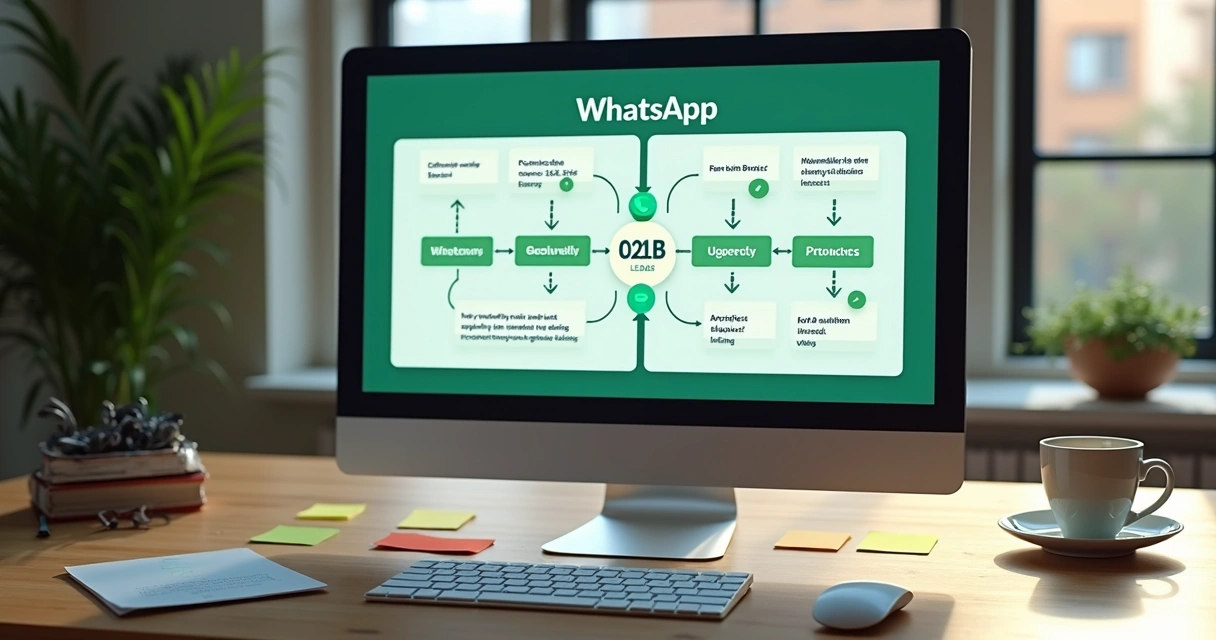
How to choose a tool without making basic mistakes
Choosing the tool is often the moment when many companies get lost. They look at too many features and too little process. Or they choose something cheap that solves today but stalls tomorrow. Or they buy a heavy system for a team that hasn’t even defined a response SLA.
We suggest starting from objective criteria.
Compatibility with the CRM and current operation
Before thinking about advanced automations, it is essential to validate compatibility. Does the tool communicate well with the CRM already in use? Does it allow creating contacts, updating fields, recording history, and moving deals through stages? Does it accept native integrations or will it depend on fragile adaptations?
It is also worth looking at the operational side. Can the sales team use it without stalling the routine? Is the transition between human service and automated flow clear? Is there visibility for management?
If the company is still choosing the main system, our guide on how to choose a CRM helps organize this decision with a focus on adherence to the operational scenario.
Ease of implementation
Not every company needs a long project to get started. Sometimes, the best path is to first activate the simplest cases: capture, screening, and basic follow-up. Tools with more accessible implementation tend to accelerate learning.
The best initial implementation is one that the team can set up, use, and adjust consistently.
Some practical points to evaluate include:
Average setup time;
Need for internal technical team;
Quality of documentation;
Ease of editing flows and messages;
Learning curve for the team.
Security and governance
Commercial WhatsApp should not be treated as loose informal conversation. There are customer data, strategic information, negotiation history, and responsibility for channel use.
Therefore, it is worth checking:
User access control;
Activity logging;
Storage of history;
Policies for using the number and account;
Quality of support in case of blocking, failure, or incidents.
Without governance, automation creates speed but can also amplify errors, data exposure, and loss of control.
Support for more than one channel
Even if WhatsApp is the center of the operation today, it is worth thinking one step ahead. Tools with a multichannel vision help when the customer journey passes through different entry points. This avoids rework in the future and preserves history in one place.
At this point, the analysis should not follow trends. It should follow real needs. At Roadmap Sales, we insist on this because we see many companies paying for structures they do not use and failing to solve the basics that hinder sales every week.
How to use automation to qualify leads
Qualification is one of the best uses of commercial automation on WhatsApp. Not because a robot knows how to sell better. But because it can organize the first contact, capture standardized data, and direct each opportunity to the right flow.
Instead of relying on questions asked in different ways by each attendant, the company defines a short script. This improves consistency and helps the CRM receive useful data from the start.
Automating initial qualification reduces noise and helps the team enter the human conversation already with minimal context.
A qualification flow can ask:
Name and company;
Number of people on the sales team;
Segment or type of operation;
Current main pain point;
If they already use a CRM or another tool;
Expected timeline for decision.
These responses feed CRM fields and can trigger rules. If the company is in the research phase, it receives material and enters a light cadence. If it needs to talk to sales soon, it is directed to priority service. If it does not have the ideal profile, the team avoids misallocated effort.
We have seen operations where the salesperson spent a good part of the day repeating three basic questions to misaligned leads. After the initial automation, the team gained more time for better meetings and more aligned proposals.
For B2B companies, this makes even more sense because the sale often requires context. The lead does not buy on impulse. They buy when they see a fit. And fit depends on diagnosis.
How to reduce failures and improve service
Commercial failure does not always appear as a big error. Often, it emerges as small losses of consistency. A delayed return. An agreement that was not recorded. A lead that received a duplicate message. A customer who had to explain the same thing to two people.
It is at this point that automation integrated with CRM helps a lot.
Better service does not come just from responding quickly; it comes from responding with history, context, and a clear next step.
Some common improvements include:
Automatic alerts for overdue follow-ups;
Transfer of conversation with a record of the reason;
Approved standard messages for recurring situations;
Updating stages according to the customer's response;
Queue by specialty, territory, or portfolio.
This does not eliminate the need for sales training. But it reduces the volume of avoidable errors. And that already changes the lead's experience.
We like to remember a simple point. The customer almost never sees your internal operation. They see fluidity or confusion. If the company responds with context, they feel organization. If each contact seems to start from scratch, they perceive misalignment, even if no one says it out loud.
The customer perceives the process.
How to measure results without falling into vanity
One advantage of integrating WhatsApp and CRM is that it allows for better measurement of what was previously dispersed. However, measuring well is not about looking at any number. It is about tracking indicators linked to the commercial journey.
If the company does not connect conversation to stage, task, and conversion, it measures volume but does not understand results.
Some useful indicators include:
Average time until the first return;
Response rate by lead origin;
Percentage of leads qualified via initial flow;
Time between qualification and scheduled meeting;
Stage advancement rate after contact via WhatsApp;
Number of automated follow-ups converted into responses;
Lost deals due to lack of contact or delays.
It is common to see companies satisfied because “the number receives a lot of messages.” This alone does not say much. What matters is the relationship between contact, qualification, advancement, and revenue.
Another caution is not to confuse automation with automatic gain. If the response rate rises, but the quality of the lead drops or the pitch becomes poor, the final result may worsen. Therefore, automations should be reviewed alongside the sales team and the CRM funnel.
If you want practical references on flows that help sell more without increasing the team, it is worth checking this content from Roadmap Sales on automations that sell more without increasing headcount.

Practical examples of automated flows
Now let’s move from theory to putting the structure into everyday scenes. These examples do not serve as a one-size-fits-all recipe. They serve to show how automation can enter small and medium-sized B2B operations.
Flow 1: Lead entry via website
Imagine a company that receives contact forms from media campaigns and product pages. Previously, someone would export a spreadsheet and then manually pass it to sales. The first return took hours. Sometimes, days.
With integrated automation:
The lead fills out the form;
The CRM creates the contact and the deal;
WhatsApp sends an initial message with a greeting and context question;
The system records responses and classifies the lead;
An SDR takes over only the leads within the profile;
If the lead does not respond, a scheduled follow-up is sent within a defined timeframe.
Main gain: speed with organization.
Flow 2: Reactivating stalled proposals
Another common case involves proposals sent that received no response. The salesperson remembers some. Others get lost.
With an automated rule, the CRM identifies deals without interaction for a certain period and triggers a flow on WhatsApp with a contextual message. Something like a brief follow-up, offering a proposal review, scope update, or new conversation.
Automated reactivation works best when it is part of a real milestone in the commercial process, such as a proposal sent or a meeting completed.
Main gain: recovering opportunities without solely relying on the team's memory.
Flow 3: Confirmation and preparation for a meeting
Many sales meetings are missed due to forgetfulness or lack of preparation from the lead. A simple sequence can help:
Scheduling in the CRM or calendar;
Automatic confirmation on WhatsApp;
Reminder the day before;
Message on the day of the meeting with a link and brief guidance;
After the meeting, sending a summary or next step.
Main gain: fewer absences and more continuity.
Flow 4: Qualification by portfolio or region
Companies with territorial or segment divisions can use rules to direct the lead to the right queue. The contact enters via WhatsApp, answers two questions, and is immediately assigned to the appropriate responsible party. This reduces manual transfers and prevents the customer from being pushed from one attendant to another.
Main gain: better distribution and less friction.
Flow 5: Hybrid service at different hours
Some companies do not have a team available during extended hours but still receive contacts outside of business hours. In this scenario, a flow can welcome the message, ask for basic data, and create a task for the first available time.
The customer feels a response. The team receives context. The process does not stop.
Strategies for small and medium B2B companies
Companies with 10 to 200 employees live a delicate balance. They have enough complexity to suffer from disorganization, but they do not always have the structure for long projects or teams dedicated solely to systems. Therefore, the strategy needs to be pragmatic.
For B2B SMEs, the best automation on WhatsApp usually starts small, focusing on clear bottlenecks and quick perceived gains.
We suggest five prioritization fronts.
Start with the point of greatest loss
It is not worth automating everything at once. First, it is worth identifying where the operation loses opportunities the most. At the entry? In follow-up? In the handoff to the salesperson? In confirming meetings? The biggest problem should be the first target.
Standardize questions and messages
Many companies try to automate before standardizing. This delays progress. If the team does not yet know which minimum questions define a good lead, the flow is weak from the start. The same goes for messages. The text needs to reflect the company’s positioning and the stage of the conversation.
Provide visibility for the manager
Automation cannot become a black box. The manager needs to see volume, stages, times, and deviations. Therefore, integration with the CRM should also be designed for management, not just for service.
Avoid excessive branching
In the beginning, overly complex flows tend to fail more. It is better to have a short design with objective questions and a clear exit for human assistance than a menu full of paths that are difficult to maintain.
Review the flow frequently
After automation goes live, the work does not end. It is necessary to observe response rates, abandonment, forwarding times, and team feedback. Small adjustments often make a significant difference.
In this type of decision, Roadmap Sales helps a lot because it starts with a diagnosis of the operation. Many companies look for a “CRM tool with WhatsApp” without clarity on what they really need. Our role, in many cases, is precisely to separate real needs from features that seem attractive in demonstrations but do little to change day-to-day operations.

Care to avoid turning automation into noise
Poorly applied automation generates rejection. And this happens faster than many imagine. Just one message sent at the wrong time, a text that is too generic, or a bot that blocks the path to human assistance.
The most common mistake is not automating too much, but automating without context, without clear rules, and without review.
Some precautions help avoid this:
Do not send a long sequence to those who have not yet confirmed interest;
Avoid artificial or excessively promotional language;
Make it clear when the service is automated;
Offer an option to speak with a person;
Respect the lead's stage and contact time;
Test flows in real cases before scaling up.
It is also worth managing internal expectations. Just because a bot has been activated does not mean the team will automatically sell more. What changes first is the operational foundation. Over time, this can improve response rates, the quality of records, and the ability to follow up. Then, the commercial gains become more visible.
We like to think of this transformation as an adjustment to the commercial structure. Less improvisation. More clarity. Less loss due to lack of routine. More capacity to grow without breaking service.
When is it worth seeking external support to decide?
In some cases, the company knows it needs to integrate WhatsApp and CRM but lacks confidence in where to start. This often happens when there are many possible tools, little internal technical maturity, and pressure for quick results.
In these moments, an impartial diagnosis helps avoid misdirection. Especially because the best choice depends on size, integrations, budget, team maturity, and the complexity of the commercial process.
Choosing the right WhatsApp and CRM structure depends more on adherence to the company’s scenario than on market fame.
If the operation is at this stage, some materials can help compare paths, such as this analysis of WhatsApp-focused solutions for commercial operations and this overview of CRM platforms with extensive resources for the commercial journey. The point is not to copy a ready-made model but to understand the fit.
At Roadmap Sales, we work precisely with this type of reading. The company answers a quick questionnaire and receives a diagnosis with options for CRMs that are more aligned with its profile and an implementation roadmap. For those looking to reduce errors and rework before investing, this significantly shortens the path.
Conclusion
WhatsApp is already part of the commercial reality for a large number of Brazilian companies. The question now is not whether it should enter the sales routine. The question is how to do this without losing control, history, and management capacity.
Integrating WhatsApp with CRM is the step that transforms scattered conversations into a trackable commercial process.
Throughout this article, we showed that commercial automation on the messenger can support screening, qualification, follow-up, distribution, meeting confirmations, and reactivation of opportunities. We also saw that the best results appear when the company starts with the right bottleneck, chooses tools compatible with its operation, and measures what truly influences conversion.
For small and medium B2B companies, this combination tends to bring more predictability, fewer execution failures, and greater clarity about the pipeline. It is not about replacing human relationships. It is about providing structure for them to happen better.
If your company wants to decide more wisely which CRM and which integration format make sense for your reality, we invite you to learn about Roadmap Sales and take the free platform diagnosis to receive a clearer path before investing.
Frequently Asked Questions
What is sales automation on WhatsApp?
Sales automation on WhatsApp is the use of messages, rules, and integrations to serve, qualify, track, and record commercial contacts in a more organized manner.
In practice, this includes automatic responses, chatbots, scheduled message sending, distribution of conversations among attendants, and connection with the CRM. The goal is to reduce repetitive tasks, maintain history, and help the team better track each opportunity.
How to integrate WhatsApp with CRM?
The integration of WhatsApp with CRM is usually done through native connectors, APIs, or intermediary platforms that synchronize messages, contacts, and funnel stages.
The process varies depending on the tool used, but generally involves configuring the business number, authorizing the connection with the account, mapping CRM fields, defining automation triggers, and testing the recording of conversations in the lead's history. It is also worth reviewing distribution rules and access permissions before scaling the operation.
Is it worth automating sales via WhatsApp?
Yes, it is worth it when the company already uses the channel frequently and needs to reduce failures, gain consistency, and better track the commercial process.
Automation helps mainly in screening, initial return, follow-up, and data recording. The benefit increases when it is connected to the CRM, because then the company can transform conversation into management information, not just isolated service.
What are the best CRMs for WhatsApp?
The best CRMs for WhatsApp are those that fit the company's size, the maturity level of the team, and the integrations required by the operation.
There is no one-size-fits-all answer. Some companies need something simple to organize contacts and history. Others need automation, multiple users, reports, and integration with marketing, service, and post-sales. Therefore, the ideal is to evaluate compatibility, ease of implementation, security, and the ability to sustain the company's real commercial process.
Does automation on WhatsApp increase sales?
Automation on WhatsApp can increase sales when it reduces response time, improves qualification, and prevents loss of opportunities throughout the funnel.
It does not generate results on its own. The increase in sales depends on the quality of the process, the messages, the handoff to human service, and the use of CRM to track progress and conversion. When these elements are aligned, the company tends to gain more commercial consistency and better leverage the demand it already receives.
Want this tailored to your stack?
Run the free assessment and get a personalized report with fit scores, tradeoffs, and rollout guidance.
Start free assessment